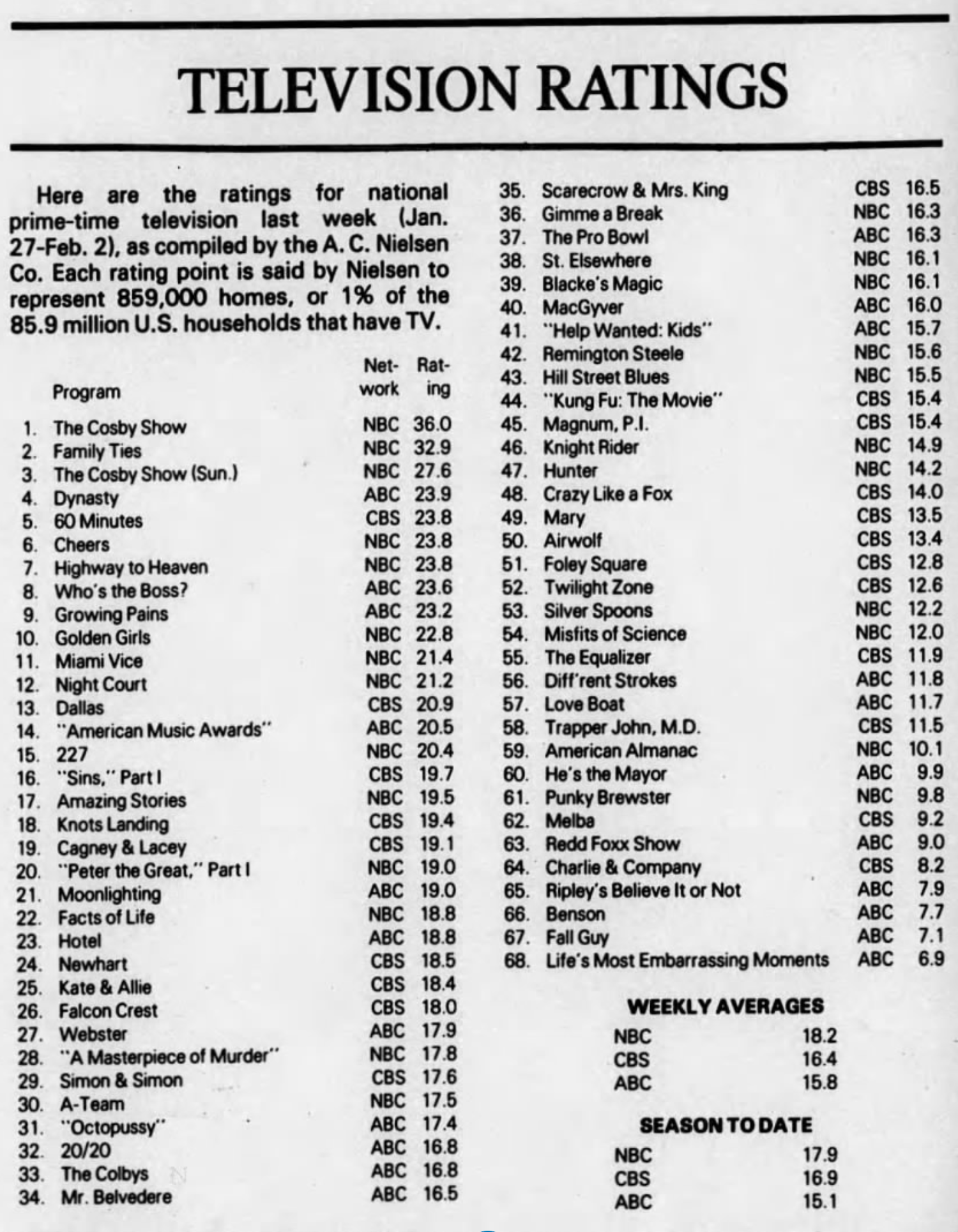
The Nielsens: February 4, 1986
What we were (and weren't) watching 40 years ago

These days, pretty much everyone walks around with a TV in their pocket, and there are so many viewing options that pretty much every show — no matter how popular it might be in the current definition of the term — is broadcast for a niche audience. But for decades, the small number of networks and the relative lack of options for rewatching anything meant that Americans watched a lot of the same stuff at the same time — and even programs that have largely been forgotten today drew what would now be considered massive ratings. In this recurring column, we take a fond and often somewhat mystified look back at the Nielsen ratings from long ago.
Who's the Boss? (ABC)
It's funny how quickly fortunes can change. If you've been following this series — or you're familiar with the history of TV ratings in the '80s — you know ABC was fully in the dumpster in 1985, with Moonlighting and Dynasty offering the only glimmers of hope in the morass. You probably also know that even though they were the undisputed ratings champ during this period, it hadn't been that long since NBC was regularly getting its ass kicked, which brings us back to where we started: It's funny how quickly fortunes can change.
For ABC, that reversal rested largely on an array of extremely silly sitcoms, basically all of which hinged on "what if X, but Y?" concepts. "What if we made a classroom comedy, but the teacher was a long-term sub?" "What if we made a mismatched buddy comedy, but one of them was from a made-up Mediterranean island?" "What if we made a family comedy, but it was about a widower raising his three daughters with the help of his brother-in-law and best friend?"
And then there were the housekeeper shows.
Housekeeper-assisted sitcoms were nothing new in the '80s; from Hazel to Gimme a Break, the notion of a regular family employing a live-in servant to cook for them and pick up their shit was an incredibly common trope. But toward the middle of the decade, that trope started wobbling in new directions — first with Charles in Charge, starring Scott Baio as a live-in nanny, and then with Who's the Boss? and Mr. Belvedere, both of which debuted on ABC within months of one another in late '84 and early '85.
We'll get to Belvedere shortly, but Who's the Boss? was the big ratings winner for ABC, giving the network one of its three Top Ten shows this week. (The others: Dynasty, of course, and Growing Pains.) Starring Taxi vet Tony Danza as ex-ballplayer Tony Micelli, the series started with Tony and his daughter Samantha (Alyssa Milano) moving to Connecticut to start a (cough) brand new life as Tony took a job as the live-in housekeeper for ad exec/single mom Angela Bower (Judith Light) — a job he landed after impressing Angela's horny mom Mona (Katherine Helmond).
The hook was the gender reversal twist of turning an athlete into a housekeeper, but the show's true angle was the will-they-or-won't-they tension between Tony and Angela, which drove a bunch of the storylines; honestly, it's to the writers' credit that they not only managed to tease it out for eight full seasons, but ended on an ambiguous note instead of falling back on a big wedding for the series finale. While Who's the Boss? was never really regarded as one of the decade's more "important" sitcoms, it had a sturdy premise and solid talent on either side of the camera; ultimately, it probably could have run a lot longer if the network hadn't decided to punt the show to Saturday nights for what ended up becoming its final season.
227 (NBC)
Saturday night was a graveyard for ABC because NBC owned it — throughout the back half of the decade, the network's Saturday primetime schedule benefited from The Golden Girls, which proved an immediate load-bearing hit after debuting in the fall of '85. Over the last 40 years, that show has obviously become a cultural touchstone, and it earned that status — but it's a shame that far less attention is paid to more of the series that rounded out that Saturday block during much of Girls' run.
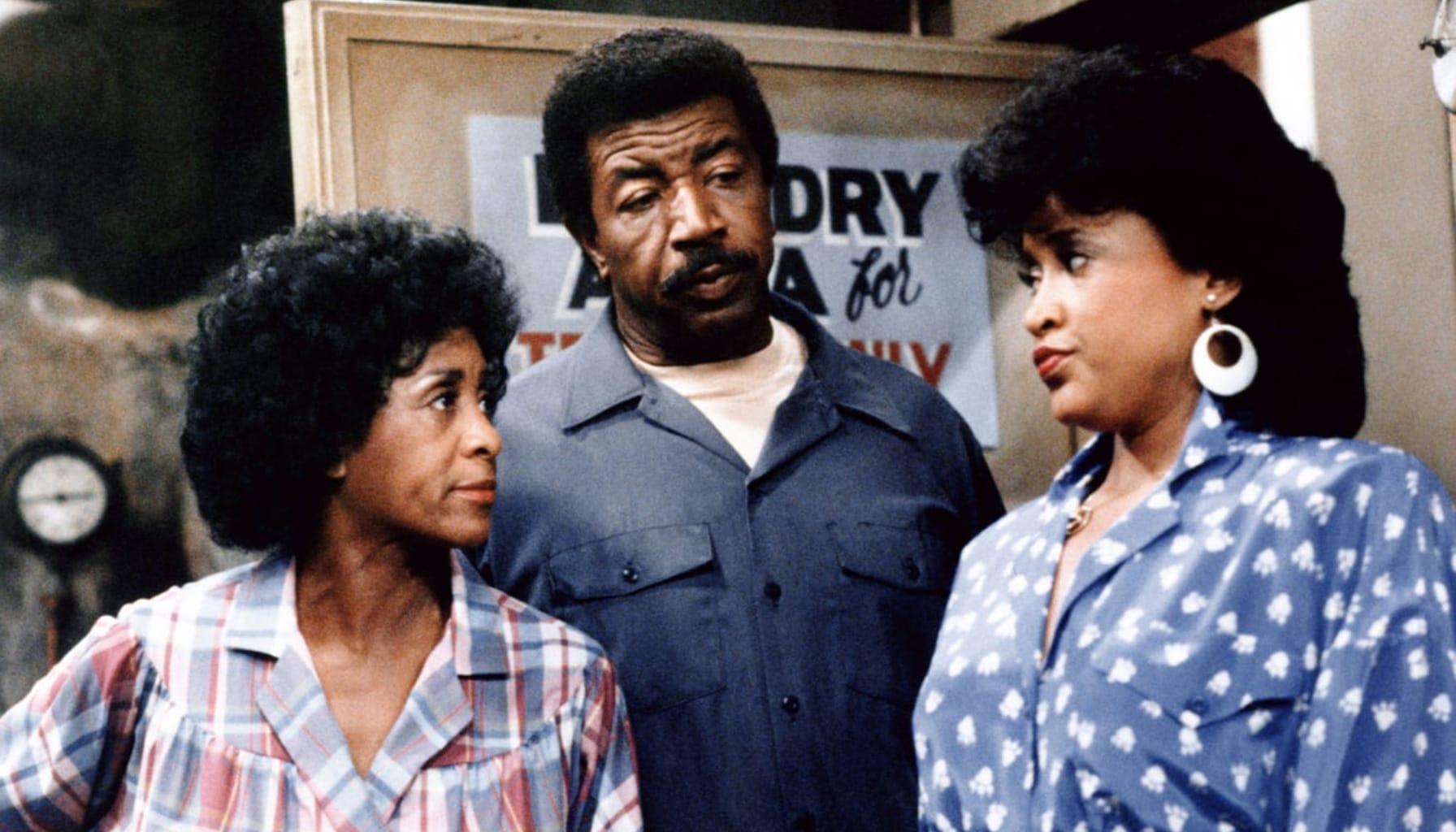
Premiering in the fall of '85 and halfway through its first season in February of '86, 227 was conceived as a star vehicle for Marla Gibbs, who was available after the long-running Jeffersons was abruptly canceled at CBS. The premise was as high-concept as they come: Gibbs played Mary Jenkins, the cornerstone of social life at 227 Lexington Place in Washington, D.C., with her stolid sensibility holding down the center while a cast of occasionally eccentric characters revolved around her. The show incorporated a number of social issues — the episode that ran this week, guest-starring Captain Lou Albano, involved the unhoused — but at its heart, it was really a Newhart-style sitcom that relied on a straight man (or woman, in this case) whose no-nonsense personality helped the show get away with all sorts of silliness.
Of course, you can't talk about 227 without mentioning Jackée Harry, who stole the show so regularly that she ended up dropping her last name and trying to make a break for it via a spinoff series; when the network declined to pick it up, she dropped out of the main cast for the fifth and final season, only making a handful of guest appearances. Whether or not it was the main reason, her absence coincided with a significant ratings drop for the show, which until then had provided steady ratings ballast alongside Amen, another Saturday night hit led by Gibbs' fellow Jeffersons alum Sherman Hemsley.
Sins, Part I (CBS)
We can't get through one of these columns without talking about at least one epic TV movie event, and this week's is a doozy: Sins, a three-part miniseries starring Joan Collins as Helene Junot, a fashion magazine magnate whose personal life and professional success are shadowed by her harrowing past as the daughter of Allied sympathizers in Nazi-occupied France. If you know your '80s TV-movie stuff, you know this is a gold-standard setup for hours of glamor and high-stakes drama in fabulous locales, and Sins left no stone unturned in its quest — starting with the cast, which surrounded Collins with an incredible array of talent that included Jean-Pierre Aumont, Joseph Bologna, Lauren Hutton, Gene Kelly, and Timothy Dalton. (Enthusiastic consumers of '80s teen comedies and/or cult classics will also happily note the appearance of Night of the Comet and Mischief star Catherine Mary Stewart, who plays Collins' character as a young woman.)
Those efforts paid off to the tune of 72 million viewers across Sins' seven-hour run. Although the reviews ran the gamut from dismissive to begrudgingly lukewarm, the audience's appetite for sexy stories of star-crossed lovers and decades-long grudges was just about bottomless during this period. If there was a cloud to CBS' silver lining here, it might have been that Sins raised the bar so high — at least in terms of production values — that there wasn't really an economically feasible way to top it. Without having done an iota of research to investigate this thought, I'm willing to say it's at least somewhat possible that Sins represents the apogee of this type of programming, in terms of small-screen glitter as well as ratings success. I suppose we'll find out as this series wears on.
Peter the Great, Part I (NBC)
Well, this is a little unfair. How is a prestige production like Peter the Great — and this was slathered in prestige, mind you, with a cast that included Maximilian Schell, Vanessa Redgrave, Omar Sharif, Laurence Olivier, and Ursula Andress — supposed to compete with the likes of Sins? I mean, a four-part look at the life of a historical figure is nice and all, but compared to the latest from the queen of trash TV, it can't help but seem stuffy and quaint, the stuff of PBS pledge drives.
Viewers evidently agreed, consigning Peter the Great's first installment to 20th place in the ratings, tying a Moonlighting rerun and barely edging out The Facts of Life. It won a trio of Emmys, however, including Outstanding Miniseries, so at least the network got to add some more shiny hardware to its mantel.
Mr. Belvedere (ABC)
As promised, we've reached the moment when it's time to talk about ABC's other wacky housekeeper comedy of the '80s. Inspired by Gwen Davenport's 1947 novel Belvedere — which was adapted into the 1948 film Sittin' Pretty, starring Clifton Webb as Belvedere — the show was primarily a culture-clash comedy pitting its prim and proper title character against the ostensibly blue-collar brood he agrees to work for.
The rub here, of course, is that any family well off enough to hire a Mr. Belvedere would have more in common with him than the Owens family. At the start of the series, breadwinner George (Bob Uecker) is a sportswriter, and his wife Marsha (Ilene Graff) is in law school; between worrying about tuition costs, maintaining their sprawling suburban home, and supporting their three kids, the idea that these two would entertain the idea of hiring out for meals, dusting, and laundry is laughable at best.
Fortunately, a lot of Mr. Belvedere was laughable in the good way, primarily due to the comedic sparks thrown by the interplay between Hewett and Uecker, as well as the antagonistic relationship between Belvedere and the youngest Owens, Wesley (Brice Beckham). Also, Leon Redbone performed the theme song, which ruled.
Like Who's the Boss?, Mr. Belvedere was never really thought of as anything more than cheerfully disposable television. Unlike Boss, it was also never really a hit; although it did well enough to survive for six seasons, it was one of those shows that putters along just under the radar, periodically surprising you with reminders that it's still on the air.
This week's episode is one of the more memorable ones in the Belvedere canon, because of its well-meaning but seriously ham-fisted attempt to combat AIDS ignorance by abruptly introducing a classmate of Wesley's who's been diagnosed with the disease. That's a lot to ask of a half-hour sitcom, but that still doesn't truly account for the decision to write, rehearse, tape, and air an exchange that ends with "Well, I've got AIDS, but other than that, I'm doing pretty good." [Studio audience laughs]
Blacke's Magic (NBC)
Going through these old ratings reports is good for a lot of incredulous laughs, because an awful lot of flops were clearly doomed to failure long before they were filmed before a live studio audience. Occasionally, though, you come across a show that really deserved a longer leash, and Blacke's Magic is a perfect case in point.
Admittedly, I didn't watch this show when it was on, and I still haven't spent much time with it. On the other hand, it starred Hal Linden as a magician who solves crimes with his con artist dad, played by Harry Morgan. Typing that out while thinking about how Blacke's Magic only lasted for 13 episodes actually makes me angry — especially considering that NBC aired it opposite Dynasty, for fuck's sake. While Magic wasn't really a ratings bomb, it never put a dent in the competition, so by May of '86, it was off the air... until 1988, when the network hauled out old episodes to paper over the gaping holes in the schedule left by the writers' strike.
We should have gotten ten seasons of this. Dummies.
Crazy Like a Fox (CBS)
Speaking of dummies, here's CBS, serving up a master class in how to wreck a budding hit before it's had a chance to really get going. Starring Jack Warden as freewheeling PI Harry Fox and John Rubinstein as his uptight attorney son Harrison, Crazy Like a Fox was a Top Ten ratings winner during its first season in 1984-'85, holding down Sunday nights alongside Trapper John, M.D. It did fine for the first half its second season, too — but then the network decided to mess with a good thing by reviving its Sunday night movie and scattering both shows to the wind. Crazy moved to Wednesday nights for seven episodes before being yanked over to Saturdays, where it limped along for another month or so before being put out to pasture.
Countless '80s shows relied on a pair of mismatched leads bickering at each other during crime-of-the-week capers, so at least in terms of its foundations, it'd be incredibly difficult to argue that Crazy Like a Fox is a lost classic. Still, there are far, far worse ways to spend an hour than watching Jack Warden grumble and bark his way through various tight squeezes. The dorks in programming should have left well enough alone.
Melba (CBS)
The Crazy Like a Fox fiasco was a classic unforced error on CBS' part, but it wasn't the network's biggest blunder of the season. On January 28, 1986, the space shuttle Challenger exploded, killing all seven of its crew members and leaving the nation reeling. While millions were glued to the news, trying to make sense of the tragedy, the folks at CBS saw fit to air... the debut episode of Melba, a sitcom starring Melba Moore as Melba Patterson, single mom and director of the Manhattan Visitors Center. Needless to say, this decision produced dismal ratings for Melba's premiere, and it was probably an extremely fireable offense; unfortunately, it was the show that paid the price, with the network yanking Melba off the schedule after a single episode. (Five more had already been taped, and aired during the late summer and early fall.)
It's no fun having your name attached to this kind of historical footnote, but Melba walked away from Melba more or less unscathed; her 15th album, A Lot of Love, arrived in the summer of '86 and spun off a pair of Number One R&B hits with "Falling" and the Freddie Jackson duet "A Little Bit More." CBS Entertainment president Bud Grant, meanwhile, resigned the following year.