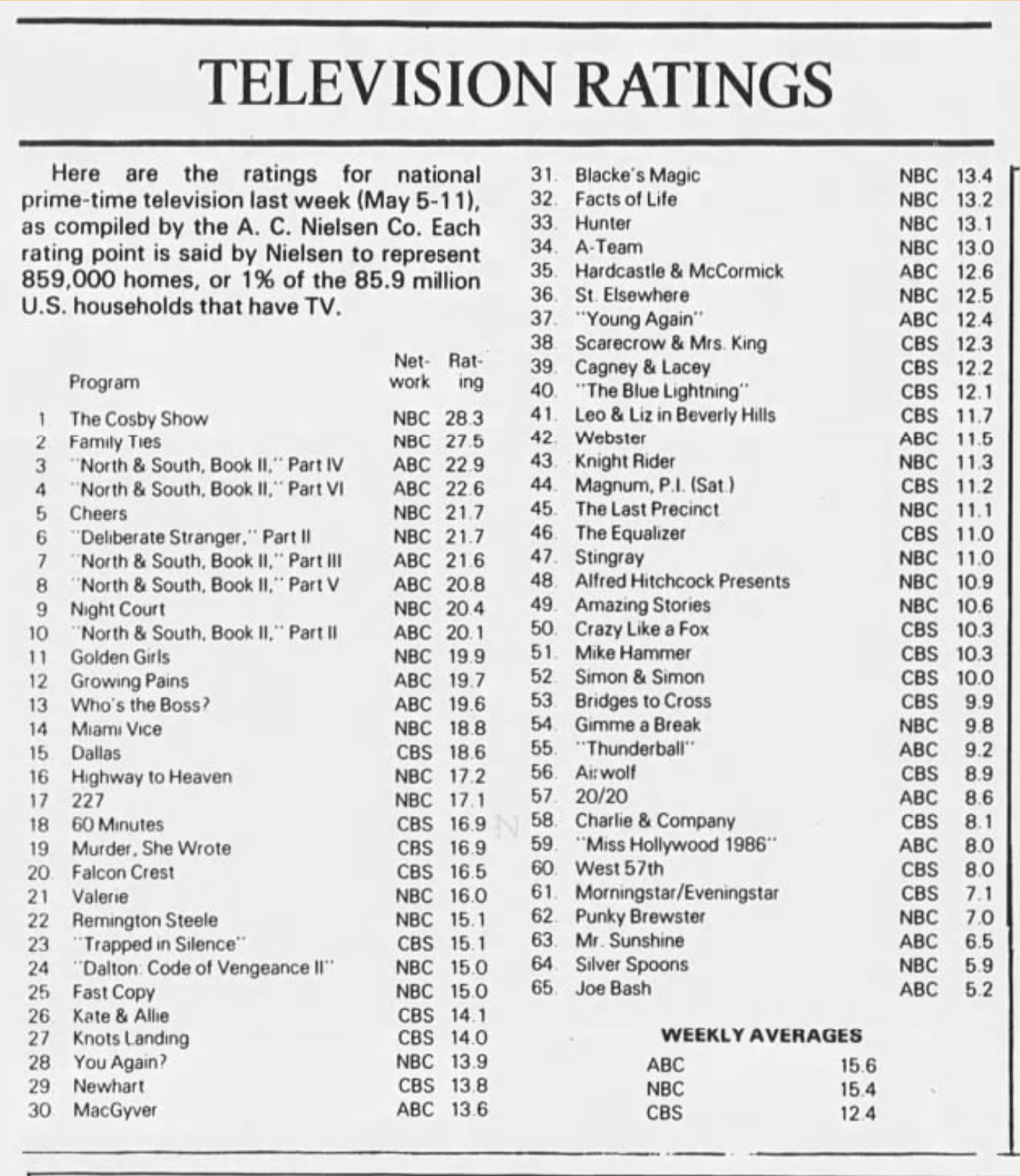
The Nielsens: May 11, 1986
What we were (and weren't) watching 40 years ago this week

These days, pretty much everyone walks around with a TV in their pocket, and there are so many viewing options that pretty much every show — no matter how popular it might be in the current definition of the term — is broadcast for a niche audience. But for decades, the small number of networks and the relative lack of options for rewatching anything meant that Americans watched a lot of the same stuff at the same time — and even programs that have largely been forgotten today drew what would now be considered massive ratings. In this recurring column, we take a fond and often somewhat mystified look back at the Nielsen ratings from long ago.
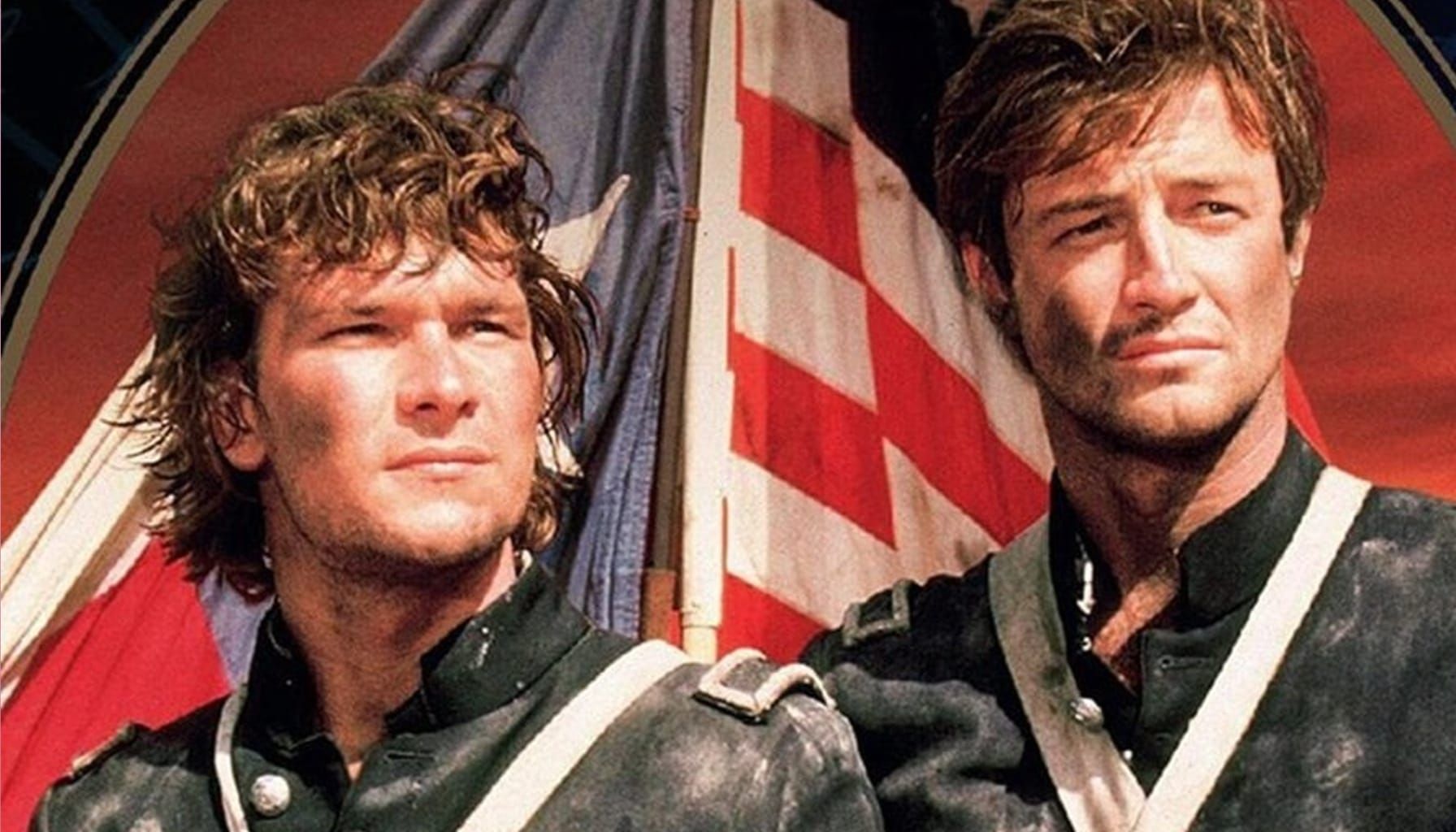
North & South, Book II (ABC)
Were this even an argument anyone on Earth was compelled to have, I think a person could make a solid case for the years 1983-'86 as the peak era of Event Television. In February of 1983, you had the MASH finale; in November of that year, you had the nuclear holocaust movie The Day After; in the fall of 1984, you had The Burning Bed; and in late 1985 through the spring of 1986, you had the sprawlingly ambitious ratings sensation that was Books I and II of North & South.
I'm glossing over some other renowned watercooler programs in there, but you get the idea — as the monoculture trundled toward its death, TV reigned supreme as a delivery mechanism for shared cultural moments, and by the '80s, the medium had evolved enough to bring impressive budgets and production values to some of the stories it aimed to tell. If you weren't around for North & South, it's hard to convey — and/or overstate — how much attention it commanded through its extremely soapy retelling of the Civil War. Just listing the cast would take up an entire post: Aside from the main cast, which included Kirstie Alley, Patrick Swayze, Lesley-Anne Down, and Genie Francis, the supporting players were a delightful fireworks display of random celebrities. Johnny Cash as John Brown! Robert Guillaume as Frederick Douglass! Hal Holbrook as Abraham Lincoln! Gene Kelly! Robert Mitchum! Elizabeth Taylor!
Again, you get the idea. Book I ended as the Civil War started, giving Book II the perfect hook to prime audiences for its sequel — and as you can see from this week's ratings, they turned out in droves, giving ABC six spots in the Top Ten. It isn't hard to see why the network tried to triple down on this bet by airing North & South Book III in 1994, but by that point, times had changed and nobody cared.
Valerie (NBC)
As you might expect, my Instagram feed is stuffed with "hey, remember this thing from the '80s?" videos. For whatever reason, the algorithm has tilted heavily toward the various opening credits from this series' run lately — and if you're at all familiar with Valerie's strange saga, you know what I mean when I say "various opening credits."
Originally launched as a starring vehicle for Mary Tyler Moore Show and Rhoda legend Valerie Harper, Valerie slotted right in with NBC's flourishing lineup of family sitcoms, and it isn't hard to understand why. Aside from Harper and her crack comic timing, the show had Jason Bateman, who had his own built-in fanbase from his years on Silver Spoons and It's Your Move, as well as Josh Taylor, who'd been a fixture on Days of Our Lives for nearly a decade at this point. It also had an absolute gem of a theme song, performed by Roberta Flack; if it isn't already buzzing through your brain as you read this, I can pretty much guarantee it will be after you watch whatever video I find to embed below.
Real ones know what happened next. After the first two reasonably well-received seasons, Harper tried to negotiate for a better deal, and the production company counter-offered by killing off her character, bringing in Sandy Duncan to copy the same trick she'd pulled on The Facts of Life, and retitling the series Valerie's Family: The Hogans. (A year later, they changed names again, settling on the simpler The Hogan Family.)
Unsurprisingly, given NBC's ability to shape the narrative and the more sexist tenor of the times, Harper was smeared in the press and portrayed as a greedy nut job; meanwhile, her former show actually rose in the ratings, establishing itself as a consistent Top 30 hit. Now, all these years later, Harper is still regarded as a TV legend, while despite running for six seasons, this show — whichever name you want to call it by — has been somewhat forgotten; as I write this post, the only way to stream it is via the Internet Archive, and it's physically available only via bootleg DVD. That theme song, though? It's eternal.
You Again? (NBC)
This is one of those shows that had a sturdy concept — estranged son moves in with grumpy dad; generation-gap laughs ensue! — but was slapped together in such a weird way that it was probably always doomed to fail. The crux of the issue with You Again? was that it found Odd Couple legend Jack Klugman, who was in his mid-60s at the time, playing father to John Stamos, who was in his early 20s. Setting aside the biological possibility of this happening, the age chasm between its leads undermined a fair bit of the humor in the premise, making the whole thing darker at the edges than the creators had to have intended. Klugman's character was so pissed off about his divorce that he hadn't seen the child that marriage produced for a decade, which is an idea that works well enough on paper if you're just trying to take advantage of Klugman's curmudgeonly persona. On camera, though, you're left looking at a guy who was in his 50s when he abandoned a kid who would have been entering his teens, which is such a childishly scummy thing for a middle-aged man to do that it sucks the laughs out of everything.
All's well that ends well, though — at least for Stamos, who turned what had started to look like a post-General Hospital career spiral into a lucrative rebound when he signed on for Full House, which premiered mere months after You Again? got the axe. Still, these are some pretty dark opening credits for an alleged sitcom:
The Blue Lightning (CBS)
1986's most popular Australian Hollywood import was undoubtedly Crocodile Dundee. Far, far, far less popular was The Blue Lightning, a CBS TV movie starring a slumming Sam Elliott as Harry Wingate, a San Francisco PI who's hired by the cartoonishly named Brutus Cathcart (played by prolific Australian actor Max Phipps) to venture into the outback and retrieve a stolen opal from the villainous Lester MacInally (Robert Culp), a former IRA sharpshooter who's somehow taken over an entire town.
Unless you are a fool, the prospect of watching Sam Elliott duke it out with Robert Culp probably sounds pretty goddamn enticing. Unfortunately, neither of them were at the top of their prospective game here; Culp was wandering around after the cancellation of The Greatest American Hero, and I'm pretty sure Elliott filmed this before Mask, which sparked a richly deserved career resurgence after years of wandering the TV movie desert. It seems safe to say that neither of them picked this project because of the script, in other words.
Critics loathed The Blue Lightning, dismissing it as an exercise in meaningless violence; my favorite pan came courtesy of the Sydney Morning Herald's Richard Glover, who went in expecting misery and was not disappointed, warning readers, "It was as bad as everybody said it was."
Leo & Liz in Beverly Hills (CBS)
Speaking of talented actors taking jobs for reasons other than quality, here's Harvey Korman and Valerie Perrine, whose careers had both seen far better days by the mid-'80s. They were therefore presumably extra susceptible to the pitch for this exceedingly short-lived sitcom, which put a very minor, very lazy spin on The Beverly Hillbillies by swapping out that show's cornpone central characters for a newly wealthy couple with dreams of climbing the 90210 social ladder. Aside from the novelty of seeing Korman and Perrine starring in a show like this, I can't imagine why anyone thought Leo & Liz in Beverly Hills would catch on with viewers, but whoever harbored those dreams didn't hang onto them for long — the show floundered around the bottom of the Nielsens for a few weeks before the network mercifully pulled the plug. Six episodes were aired in all.
The Last Precinct (NBC)
The sole sitcom to ever spring forth from the mighty Stephen J. Cannell Productions, The Last Precinct looked pretty good on paper — in fact, it seemed like a solid enough idea for NBC to give the pilot the plum post-Super Bowl berth in early '86. Starring Adam West as the captain of a last-chance police precinct, the show sought to put a Night Court-style spin on the cop sitcom formula; rather than wringing laughs out of anything an actual officer might do, it tossed a bunch of wacky characters in a blender and waited for the magic to happen. Alas, it never did, despite a supporting cast that included Ernie Hudson and Keenan Wynn. This probably had a lot to do with the fact that NBC waited until mid-April to put The Last Precinct on the schedule, ruining whatever momentum might have been established by airing that pilot after the big game; additionally, the show's hourlong format was a really awkward fit for a sitcom, and it suffered from unfavorable Police Squad! comparisons. Still, not the worst show we've seen this week.
Bridges to Cross (CBS)
Here's another six-episode wonder from CBS' spring '86 schedule, and yet another series that tried to generate quick ratings by trotting out a familiar face. In this case it was Bob Newhart Show veteran Suzanne Pleshette, starring as Tracy Bridges, a journalist who works with her ex-husband Peter Cross (Nicolas Surovy) at a Washington, D.C. magazine. Bridges to Cross! Get it?
Bridges to Cross rose from the ashes of Pleshette's previous show, the similarly short-lived Suzanne Pleshette Is Maggie Briggs, which was a sitcom about reporters. Recognizing it was difficult to get laughs out of that setup, the network tried again with a drama, only to discover that perhaps genre wasn't the problem. Pleshette is great, and Bridges boasted an interesting supporting cast that also included Roddy McDowall, Eva Gabor, and a pre-Bart Simpson Nancy Cartwright, but who cares about exes working at a magazine? Viewers certainly didn't — Bridges was off the air by the middle of June.
Morningstar/Eveningstar (CBS)
This show's concept is proof that something can be simultaneously brilliant and corny as hell. Here's the napkin pitch: After the Morningside orphanage burns down, the pint-sized residents are forced to find new digs... at the nearby Eveningside retirement home. To the network execs at CBS, who were tired of having their asses kicked by hourlong family-friendly dramas like Highway to Heaven, this sounded great, particularly since they were being pitched by Fred Silverman, former head of CBS, ABC, and NBC. Silverman's CBS tenure produced some of the best shows in the history of television, while his ABC run gave the world lowbrow hits like Charlie's Angels. (The ratings magic ran out at NBC, but nothing lasts forever.)
Noting that shows like Highway had strong demographic appeal to young and old viewers alike, Silverman figured a show could really rake 'em in with a cross-generational cast; after stumbling across an old script for a doomed sitcom take on the Morningstar/Eveningstar concept, he decided to retool it as a drama, and, well, here we are. The kids (including a young Joaquin Phoenix, still being billed as Leaf) were TV cute, the retirees were played by ace veterans such as Mason Adams, Sylvia Sidney, Scatman Crothers, and Kate Reid, and the stories were bland enough to wash down with Sunday dinner.
Unfortunately, CBS elected to air Morningstar/Eveningstar on Tuesdays, as part of a wholly ill-fated programming block that also included Foley Square, Mary, and Fast Times. As an added kick in the nuts, it was forced to face off against the instant hit Perfect Strangers, which dance-of-joyed it off the schedule after seven episodes.
Mr. Sunshine (ABC)
Before achieving name-brand status with his roles in Arrested Development and Transparent, Jeffrey Tambor spent years and years as a "that guy" actor, racking up a series of distinctive parts in films (...And Justice for All) as well as TV series (Hill Street Blues, The Ropers) that never seemed to lead to anything bigger. One of the first signs that his career trajectory might change came with Mr. Sunshine, an ABC sitcom about a university professor who's trying to readjust to life after losing his eyesight.
Reviews were generally pretty kind, while acknowledging a certain number of unnecessarily tasteless sight gags. Disability advocates were distinctly unamused, but I'm not sure controversy was Mr. Sunshine's biggest problem. The show's main issue is probably that ABC chucked it onto Friday nights at 9, where it was fumbling to find anything to keep viewers from peacing out after Webster and Mr. Belvedere — neither of which were exactly setting the ratings on fire in their own right. When Mr. Sunshine failed to score out of the box, the network left it for dead, eventually burning off the last of its 11 episodes during the summer. Short-lived as it was, the series had an impact on Tambor's life: Studying for the role led to him volunteering at the Braille Institute.
Joe Bash (ABC)
Speaking of actors who'd eventually find steady TV work elsewhere, here's Peter Boyle, whose run of big-screen '70s successes had sputtered into a dry spell. He was still working consistently, but the roles weren't exactly inspiring, so it isn't hard to understand what drew him to Joe Bash.
The brainchild of Barney Miller creator Danny Arnold, Bash was a dramedy back when the networks were still trying to figure out how to sell dramedies — and it was a pretty dark one to boot, centering on a title character whose decades on the police force had left him embittered and cynical. Despite Boyle's character's sour outlook, Arnold saw the show as a sort of tragicomedy, albeit one without a laugh track.
In other words, Joe Bash was a show before its time. Critics were kind to it, but ABC's timid approach to promoting it didn't help — and neither did exiling it to the same Friday night graveyard where Mr. Sunshine's corpse would also soon be found.