The One After the One-Hit Wonder: Louie Louie, "I Wanna Get Back with You"
He was "Sittin' in the Lap of Luxury." Then Luxury stood up and left the room

At my last job, publicists were the bane of my existence, perpetually swarming my inbox with requests to do this or that VERY URGENT THING for their client. Even now, years later, if my kids see me scowling, they're liable to say I'm making "publicist face."
Those publicists were certainly a pain in my ass, but I always knew they were just doing their job — and it's a fairly thankless job, too; one where success is rarely if ever attributed to your efforts, but failure is largely yours to bear. This is particularly true where young artists are concerned — writers like me often fall back on saying that the label/studio/etc. failed to effectively promote a project, and as true as that generally tends to be, framing it that way effectively erases all the variables that go into effectively promoting anything. Timing, the marketplace, and plain old luck all come into play. And sometimes, you can have all that stuff on your side, but still come up against the lack of an effective hook to get the audience's attention when you're trying to tell the artist's story.
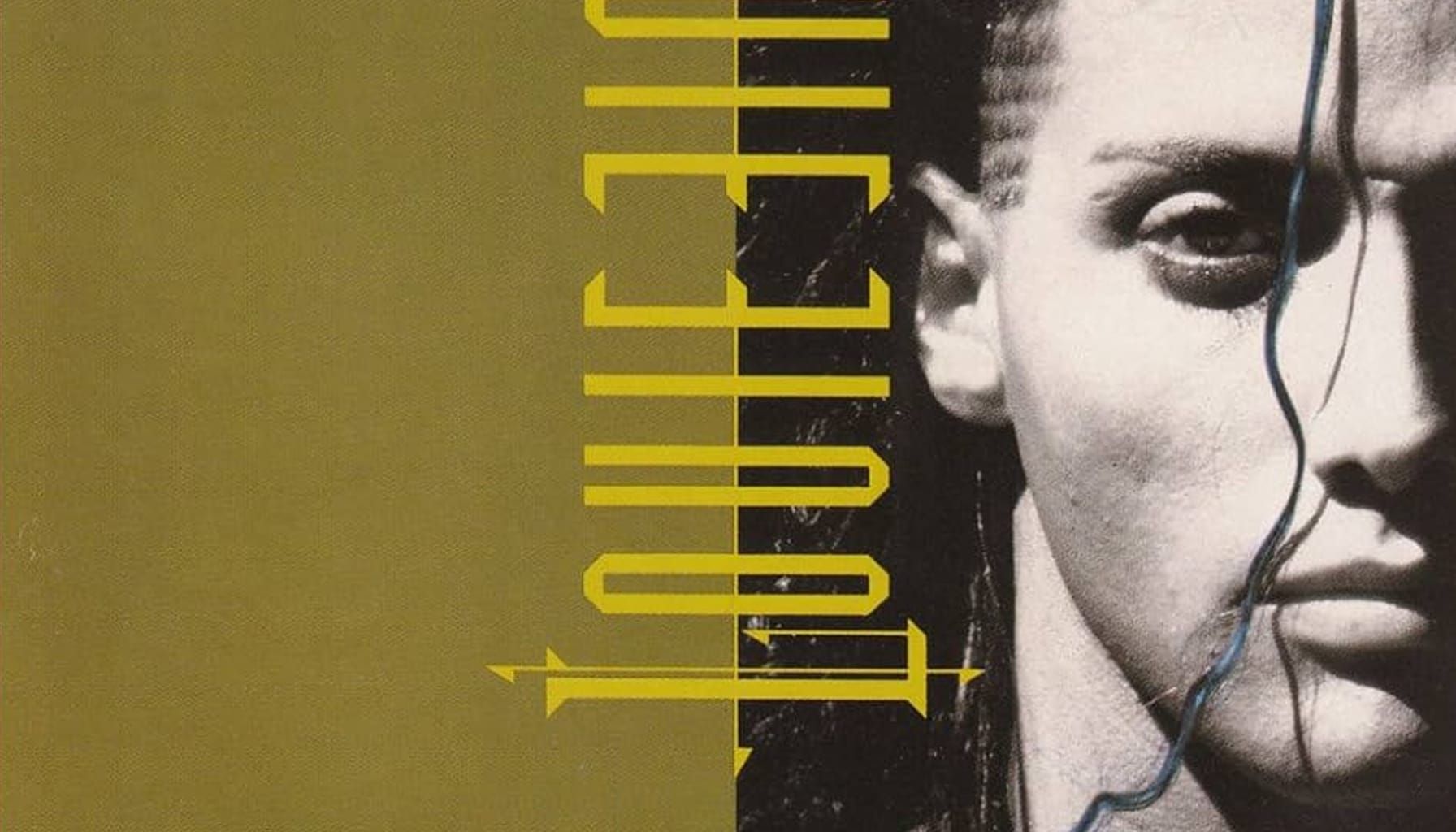
I don't know the name(s) of the publicist(s) who repped Louie Louie's 1990 LP The State I'm In, but I can tell you this much: they definitely didn't have to worry about an effective marketing hook. For G.I. Joe, knowing is half the battle; for this crew, half the battle was being handed an album of zeitgeist-friendly dance-pop, recorded by a guy who looked like a model and whose face was already familiar to millions by virtue of the fact that he'd played Madonna's boyfriend in the "Borderline" video. This is the type of assignment that you deserve to be fired for fucking up.
To his credit, Louie Louie (or, as his parents called him, Louis Edmond Cordero) was more than a pretty face. Although he was a professional dancer before he started singing, he later attributed this to nerves; as he told the Los Angeles Times in 1990, "I always wanted to be a singer, but I didn't think I could... [so] I pursued dancing. You need confidence. As soon as you get the confidence to sing, you can sing."
The back half of that quote serves as a bit of foreshadowing toward Mr. Louie's unfortunate tendency to mistake sheer obviousness (or abject silliness) for profundity, but let's focus on the good stuff first. He spent years refining his musical act, putting together a band and playing date after date in local clubs, and after getting signed, he seemed glad for that time in the trenches. "You have to have a point of view, a style," he said in the same interview. "I think I had that before my music did."
That's a really gracious way of addressing your own early artistic deficiencies, and if Louie had indeed developed a point of view or style worth building an entire career around, then I think we'd be here to discuss a very different story. Unfortunately, he turned out to be the type of songwriter who has no evident grasp of his own strengths or limitations.
If you remember Louie Louie's one hit, the No. 19 "Sittin' in the Lap of Luxury," you know it's a perfectly 1990 song, one that fit right in alongside Brother Beyond's "The Girl I Used to Know" and Calloway's "I Wanna Be Rich" and the Ray Charles/Chaka Khan cover of "I'll Be Good to You" and... well, you get the idea. The production is tinny, the hooks are obvious and naggingly insistent, and it's all innocuous enough to tolerate. What you may not remember is that it's a song about a guy who's "an ugly duckling, only half a man," so in order to meet women, he decides to start "chargin' by the hour for my love power," only to discover that his quest for affection has led him down a dead-end path. The payoff comes at the end of the chorus, which drops the truth bomb "The moral of the story is gigolos / Gigolos get lonely too."
In Louie's defense, this was an era when artists were encouraged to wedge serious issues and social concerns into their music. "Lap of Luxury" arrived months after Phil Collins' "Another Day in Paradise," and around the same time as Michael McDonald's "Homeboy," a song that's more embarrassing than almost everything on The State I'm In. And thanks to a left-field cameo from Dizzy Gillespie, none of this track's lyrical deficiencies really mattered; while it would be deeply misguided to try and argue that "Sittin' in the Lap of Luxury" is a classic of its genre or its era, it's fun and memorable enough that it should have led to another hit.
You already know that this was not to be, and we've been down this road together enough times that you probably also already know a number of different factors conspired to exile Louie Louie from the Hot 100 as quickly as he arrived. It's worth noting that he was on WTG Records, a Columbia imprint launched in 1988 by label execs Walter Yetnikoff and Tommy Mottola with ex-Atlantic president Jerry Greenberg. The label's brief was to strengthen the historically New York-focused Columbia's presence in L.A., which proved to be about as unfocused in practice as it was in theory. During its short-lived initial existence, WTG's roster highlights included Motörhead, Pauly Shore, and Louie's fellow one-hit wonders Bonham and Jimmy Harnen. The moral of the story is that this is a label that knew how to make a decent-sized initial splash with its signings, but lacked the ability and/or willpower to follow through.
In fairness to WTG, it's also worth noting that the rest of The State I'm In isn't very good. Most of it is just anonymous-sounding dance pop, and the stuff that's left is memorable for all the wrong reasons. Before listening to the album, I read Louie's 1990 interview with the Los Angeles Daily News, which begins on a wincingly klutzy note by saying he "could be mistaken for Latin, Black, or anything in between" and then moves on to this ominous quote:
"I don't want to come across like a father figure, but more like a big brother. I'm real good at explaining things, and music allows me the opportunity to explain some complex issues."
The two best examples of Louie trying to "explain some complex issues" are probably the tracks "Let Me Divorce You," which is about divorce, and "Penny Lady," which details his encounter with an unhoused person. I'm not willing to transcribe the lyrics here; instead, I'll just quote a Los Angeles Times concert review, which singles it out as the low point of Louie's set by calling it "a pathos-laden ode to a homeless woman in which Louie Louie offers her not food or shelter but a copy of his album."
WTG wisely opted not to go with one of Louie's social statements as a follow-up single, but their other options were all pretty unappealing. This isn't one of those One After the One-Hit Wonders where you come away wishing someone had heard the hit potential in a song that would have altered the trajectory of a young artist's career. If there's anything positive to be said about the bulk of The State I'm In, it's that it might make you nostalgic for the days when people forced themselves to learn an album's songs by heart simply because they'd already invested a week's allowance and they only owned a dozen other records. I can absolutely imagine a crowd full of teenagers singing along with multiple Louie Louie songs during one of his 1990 tour dates (opening for Erasure!); I can also imagine The State I'm In cassettes gathering dust behind empty shoeboxes and old report cards in the backs of closets across America the following year. Despite his efforts, this album feels more like a marketing gambit than an artistic statement.
There really isn't anything to say about "I Wanna Get Back with You." As tended to be the case with a lot of his songs, the title tells you everything you need to know. I've listened to it three or four times while putting this post together, and I don't remember a single thing about it, other than it's about wanting to get back together with someone. Your mileage may vary, but I sort of doubt it. The best case scenario for a song like this is that it ends up landing deep on the second side of a soundtrack album:
Afterburners fading fast, The State I'm In peaked at No. 136, and plans for a WTG follow-up were abandoned when — according to legend — Louie "cussed out" Mottola during a meeting. I have no idea whether that actually happened, but it would go along way toward explaining the stone commercial silence that greeted the rest of his recorded output; as Mariah Carey can attest, Mottola was not someone you wanted as an enemy. Louie still managed to land a new record deal, but his second LP, Let's Get Started, went absolutely nowhere despite boasting production from George Michael and Prince. Prior to that album's release, Louie said he was also working on the screenplay for a film in which he would star as "a renegade kind of preacher"; that project presumably fell by the wayside after the first few sales reports for Started came in.
From there, things got even worse. Reverting to his birth name for his third LP, Louie Cordero, Louie signed with Trauma, the label responsible for early hit efforts from Bush and No Doubt. It sold 600 copies. It'd be another six years before he released his fourth and final album, Dance Love Work; like the two that came before it, it failed to chart.
The elephant in the room here is that Louie Louie died last month at the age of 63, which puts an awfully dark period at the end of a post about a recording career that was largely defined by missed opportunities. That's why I'm getting it out of the way before talking about what Cordero did after the spotlight faded: Rather than flailing for another go at the brass ring, he went to Vegas, where he led shows during a variety of engagements at clubs on the Strip. By all available accounts, he was the furthest thing from bitter about how fast his star fell.
"I’m writing and performing because it makes me feel wonderful and alive," he told the LAT in 1997. "I won’t be thrilled if my next record doesn’t explode, but whatever happens, no one can ever take Louie Louie away from me."
This, probably more than any other final act in a One After the One-Hit Wonder post, counts as a happy ending. I think the evidence strongly suggests that Cordero was probably not a born songwriter, but he was certainly a capable singer, talented dancer, and charismatic performer, and he clearly loved being on stage no matter how many people happened to be in the audience. So many show business stories end in bitterness and confusion; while it's sad that Cordero died at a relatively young age, it's inspiring to know he spent so many of the years he had doing exactly what he wanted to do.